Skip to content














The tankless water heater vs tank choice comes down to how much hot water you use at once. A tank stores 40 to 80 gallons and costs less to install. A tankless unit heats water on demand, uses less energy and lasts longer. Our tankless water heater installation team helps Triad homeowners pick the right fit.
Most people only think about this when the old heater quits. That is the worst time to decide. This guide walks you through cost, efficiency, lifespan and sizing so you can choose before your basement floods.
Key Takeaways: Tankless Water Heater vs Tank
- Efficiency: tankless units can be 24% to 34% more efficient for homes using 41 gallons of hot water a day or less.
- Lifespan: most tankless models last 20+ years, while tank heaters last about 10 to 15 years.
- Upfront cost: a tank is cheaper to buy and simpler to swap. Tankless often needs gas line, venting or electrical upgrades.
- Hot water supply: tankless never runs out, but it can struggle when several fixtures run at once.
- Maintenance: both need yearly care, and hard water makes that care more important.

How a Tank Water Heater and a Tankless Unit Work
A storage tank water heater keeps a full tank hot all day. When you open a tap, hot water leaves the top and cold water refills the bottom. The burner or element then kicks on to reheat it.
A tankless water heater has no tank. Cold water flows through a heat exchanger, and a gas burner or electric element heats it only while the tap is open.
What Is Standby Heat Loss?
Standby heat loss is the energy a tank wastes keeping stored water hot when nobody is using it. Tankless units skip this loss completely. That is where most of their savings come from.
Gas vs Electric Models
Both styles come in gas and electric versions. Gas tankless units need proper venting and often a larger gas line. Electric tankless units can need a big jump in amperage, which may mean a panel upgrade.
Tankless Water Heater vs Tank: Side-by-Side Comparison
This table puts the main differences in one place. Use it as a starting point, then match it to your household size and budget.
| Factor | Tank Water Heater | Tankless Water Heater |
|---|---|---|
| How it heats | Stores and reheats 40 to 80 gallons | Heats water only on demand |
| Energy efficiency | Loses heat on standby | 24% to 34% more efficient (under 41 gal/day) |
| Typical lifespan | 10 to 15 years | 20+ years |
| Upfront cost | Lower | Higher, plus possible gas or electrical work |
| Hot water supply | Runs out when the tank empties | Endless, limited by flow rate |
| Space needed | Large floor footprint | Small, wall mounted |
| Yearly care | Flush sediment, check anode rod | Descale heat exchanger, clean inlet filter |

Which One Uses Less Energy?
A tankless unit uses less energy in most homes. According to the U.S. Department of Energy, demand water heaters can be 24% to 34% more efficient than storage tanks for homes that use 41 gallons or less of hot water daily.
The gap shrinks for big households. Homes using around 86 gallons a day see about 8% to 14% better efficiency, based on the same Department of Energy data. Savings grow when a separate unit serves each hot water outlet.
When a Tank Still Makes Sense
- You plan to sell the house within a few years.
- Your budget is tight and the current venting and gas line fit a tank.
- Your family runs showers, laundry and the dishwasher at the same time every day.
- You want the simplest same-day swap after a failure.
How Long Does Each Type Last?
Lifespan is where tankless pulls ahead. The Department of Energy notes most tankless units last more than 20 years, and many parts are easy to replace. Storage tank heaters usually last 10 to 15 years.
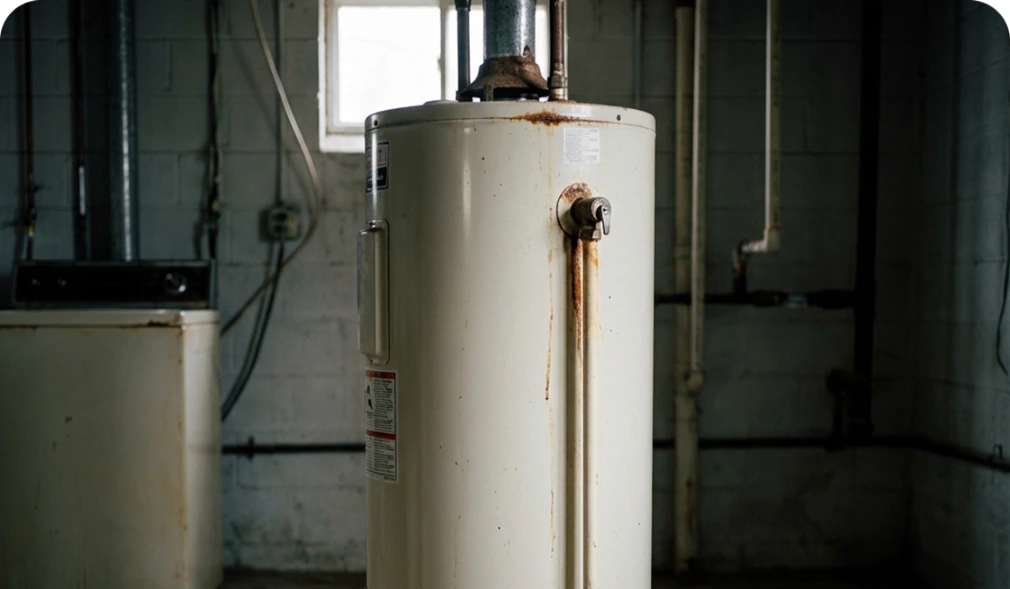
A tank fails when its steel lining rusts through, and a leaking tank cannot be fixed. If your tank is past 10 years, our water heater replacement service can tell you honestly whether to repair or replace.
Signs Your Tank Is Near the End
- Rusty or brown hot water
- Rumbling or popping sounds from sediment
- Water pooling around the base
- Hot water running out faster than it used to
- The unit is 10 or more years old
What Does Each Option Cost Up Front?
A tank water heater costs less to buy and install, especially when the new unit matches the old hookups. A tankless heater costs more because the unit is pricier and the job often includes extra work.
That extra work can include a larger gas line, new stainless venting, a condensate drain or a new electrical circuit. The Department of Energy points out that lower operating costs and a longer life can offset the higher purchase price over time.
At All-Star Plumbing, you get upfront pricing approved before any work starts, and there is no charge if you decline the quote. Wisetack financing is also available on water heater replacement, from $500 to $25,000 with terms from 3 to 60 months.
How to Size a Tankless Water Heater for Your Home
Tankless units are sized by flow rate in gallons per minute (GPM), not by gallons stored. Pick a unit that can handle every fixture you run at the same time.
- List your fixtures that run together. For example, two showers and a kitchen faucet.
- Add up their flow rates. Check the GPM rating stamped on each fixture or its box.
- Find your temperature rise. Subtract your incoming water temperature from your target, usually 120 degrees.
- Match a unit to both numbers. The unit must deliver your total GPM at that temperature rise.
- Check gas and venting capacity. A licensed plumber confirms your gas line and vent route can support it.
Winter matters here in the Piedmont. Colder incoming water means a bigger temperature rise, so a unit that feels strong in July can feel weak in January.
Hard Water and Your Water Heater in the Triad
Minerals in hard water build scale inside both types. The U.S. Geological Survey hardness scale rates water above 120 mg/L as hard and above 180 mg/L as very hard.
Scale settles as sediment in a tank and coats the heat exchanger in a tankless unit. Many Triad homes on private wells run harder water than city supply. A water softener system install protects either heater, and yearly water heater maintenance and flushing keeps it running strong.
Frequently Asked Questions
What are the downsides of a tankless water heater?
A tankless water heater costs more up front and may need a larger gas line, new venting or an electrical upgrade. It can also struggle when several fixtures run at once, and hard water means it needs yearly descaling.
Is it worth replacing a tank water heater with a tankless?
It is often worth it if you plan to stay in your home for many years. Tankless units can be 24% to 34% more efficient for smaller households and last 20+ years, which helps offset the higher install cost.
Can you run two showers with a tankless water heater?
Yes, if the unit is sized for it. Add the flow rates of both showers, account for winter water temperature, and choose a model rated for that total gallons per minute.
Why does my shower go cold with a tankless water heater?
Common causes are a unit that is too small for the demand, scale buildup on the heat exchanger, a clogged inlet filter or a flow rate below the minimum needed to fire the burner.
Get Help Choosing the Right Water Heater in the Triad
For most small and mid-size households, the tankless water heater vs tank decision favors tankless for efficiency and lifespan. A tank still wins on upfront cost and simple swaps. The right answer depends on your hot water habits, your gas or electric setup and how long you plan to stay.
Call All-Star Plumbing of the Triad at (336) 462-1080 and a real person will answer, 24/7. Our licensed plumbers (NC License #15130) have served High Point, Greensboro, Winston-Salem and the Triad since 2007, and if we can’t fix it, you don’t pay.